

AI Scribes in Women’s Health: Transforming documentation at Women’s Health Road
Dr Talat Uppal, Director of Women's Health Road, has been featured in not one but two publications on the role of AI scribes in clinical practice — O&G Magazine (the journal of RANZCOG) and the AI Health Alliance. Together, they paint a comprehensive picture of how WHR is harnessing technology to deliver better care for women.
📄 Read the O&G Magazine article →
📄 Read the AI Health Alliance interview →
Key Takeaways
The clinical problem we set out to solve
Heavy menstrual bleeding affects 1 in 4 women of reproductive age, with two-thirds of those women experiencing iron deficiency as a result. Despite this, the condition remains under-recognised and inadequately addressed — with many women enduring symptoms for years before seeking care. Dr Talat's vision extended beyond simply finding a note-taking tool; she wanted to build a digital ecosystem that could raise awareness, improve health literacy, and create more accessible pathways to care for women.
What is an AI scribe?
An AI-powered scribe is an ambient digital tool that works in the background during consultations, transcribing the conversation in real time and organising it into structured clinical notes. It can also generate GP letters, care plans, and patient-facing action plans — reducing the administrative burden on clinicians and enabling more time for meaningful patient care. At WHR, the scribe has been in use since the end of 2023 and is now fully integrated into our practice management system, creating a seamless, unified workflow.
Our templates were built in-house — by our own team
One of the most significant steps in making the AI scribe work for WHR was developing bespoke consultation templates. Our Practice Manager Sarah worked closely with Dr Talat to build and maintain the full bank of templates used for all consultation and operation notes at WHR. Different templates exist depending on the purpose of the consultation and whether or not procedures are performed — including templates for IUD insertions, colposcopies, menopause management, and more.
Importantly, Sarah incorporated FIGO's Abnormal Uterine Bleeding (AUB) parameters directly into the templates, standardising the way patients’period-related symptoms are recorded across all consultations. The images below (as published in the O&G Magazine article) show how this has been implemented:
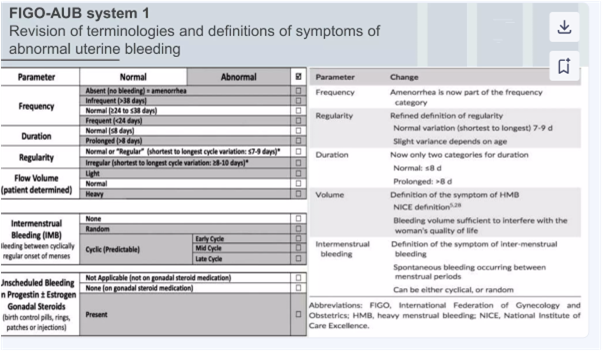
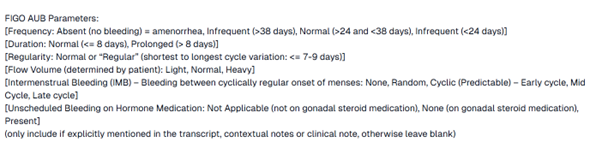
The FIGO AUB parameters are coded into the AI scribe template to help standardise how patient menstrual details are captured. (Template created by Sarah Yeomans, 2024)
This standardisation not only improves consistency in clinical documentation — it also supports AUB-based research and audits, an important step in advancing women's health outcomes.
Data security and patient consent are central to how we operate
Our AI scribe meets stringent data security standards including GDPR, Australian Privacy Principles (APP), ISO27001, SOC2, and HIPAA compliance. All patient data is stored exclusively within Australia. Patients are fully informed about the AI scribe and can opt out at any time — consent forms, signage in the clinic, and a QR code in each consultation room all make this transparent.
Workflow changes — more presence, not fewer minutes
The AI scribe has not shortened appointment times, but it has meaningfully improved the quality of what happens within them. With less focus on note-taking, Dr Talat can be more present and attentive during consultations — and reports significantly less fatigue at the end of the day. Because templates are shared across the clinical team rather than assigned to individual clinicians, there is also greater consistency in how information is recorded and communicated between WHR specialists and GPs.
Clinical governance — accuracy and accountability
Every note generated by the AI scribe is reviewed line by line before being finalised. WHR has reached approximately 95% accuracy, and all clinicians at the practice have read the relevant guidance on AI scribes from Avant, RACGP, and AHPRA. The scribe operates within a broader framework of continuous monitoring and quality improvement — and clinicians remain fully responsible for all notes at all times.
Multilingual capability supports our diverse community
The scribe currently supports 26 languages — an essential feature for a practice committed to equitable, inclusive care across multicultural Australia.
We've future-proofed our digital infrastructure
WHR operates with a practice management system that has FHIR (Fast Healthcare Interoperability Resources) capability and SNOMED terminology coding — laying the groundwork for seamless, standardised health data exchange across systems as Australian digital health continues to evolve.
AI scribes are a work in progress — and that's okay
As Dr Talat notes in the article, the AI scribe will always be evolving. Occasional technical issues occur, and training is an ongoing process. The goal is to keep pace with the technology's growing capabilities while continuously improving accuracy and outputs.
AI scribes are not just solving an administrative problem — they are transforming how we deliver care, making healthcare more connected, equitable, and patient-centred. For women's health in particular, the benefits are only beginning to unfold.
This article draws on content published in O&G Magazine and the AI Health Alliance, and includes additional context from the WHR team.
📄 Read the O&G Magazine article — Vol. 26, No. 4, Summer 2024
📄 Read the AI Health Alliance interview